͏‌ ͏‌ ͏‌ ͏‌ ͏‌ ͏‌ ͏‌ ͏‌ ͏‌ ͏‌ ͏‌ ͏‌ ͏‌ ͏‌ ͏‌ ͏‌ ͏‌ ͏‌ ͏‌ ͏‌ ͏‌ ͏‌ ͏‌ ͏‌ ͏‌ ͏‌ ͏‌ ͏‌ ͏‌ ͏‌ ͏‌ ͏‌ ͏‌ ͏‌ ͏‌ ͏‌ ͏‌ ͏‌ ͏‌ ͏‌ ͏‌ ͏‌ ͏‌ ͏‌ ͏‌ ͏‌ ͏‌ ͏‌ ͏‌ ͏‌ ͏‌ ͏‌ ͏‌ ͏‌ ͏‌ ͏‌ ͏‌ ͏‌ ͏‌ ͏‌ ͏‌ ͏‌ ͏‌ ͏‌ ͏‌ ͏‌ ͏‌ ͏‌ ͏‌ ͏‌ ͏‌ ͏‌ ͏‌ ͏‌ ͏‌ ͏‌ 
Is this email not displaying correctly? View it in your browser.
Image description

Alliance for Vulnerable Mission Bulletin

November 2026

Volume 18, Number 11

Image description

Archived back-copies here. Subscribe for free here.

Editor: Jim Harries, PhD

The Alliance for Vulnerable Mission encourages some missionaries from the West to engage in their ministries using local languages and resources.

Please suggest contributions to this Bulletin to [email protected]

Image description

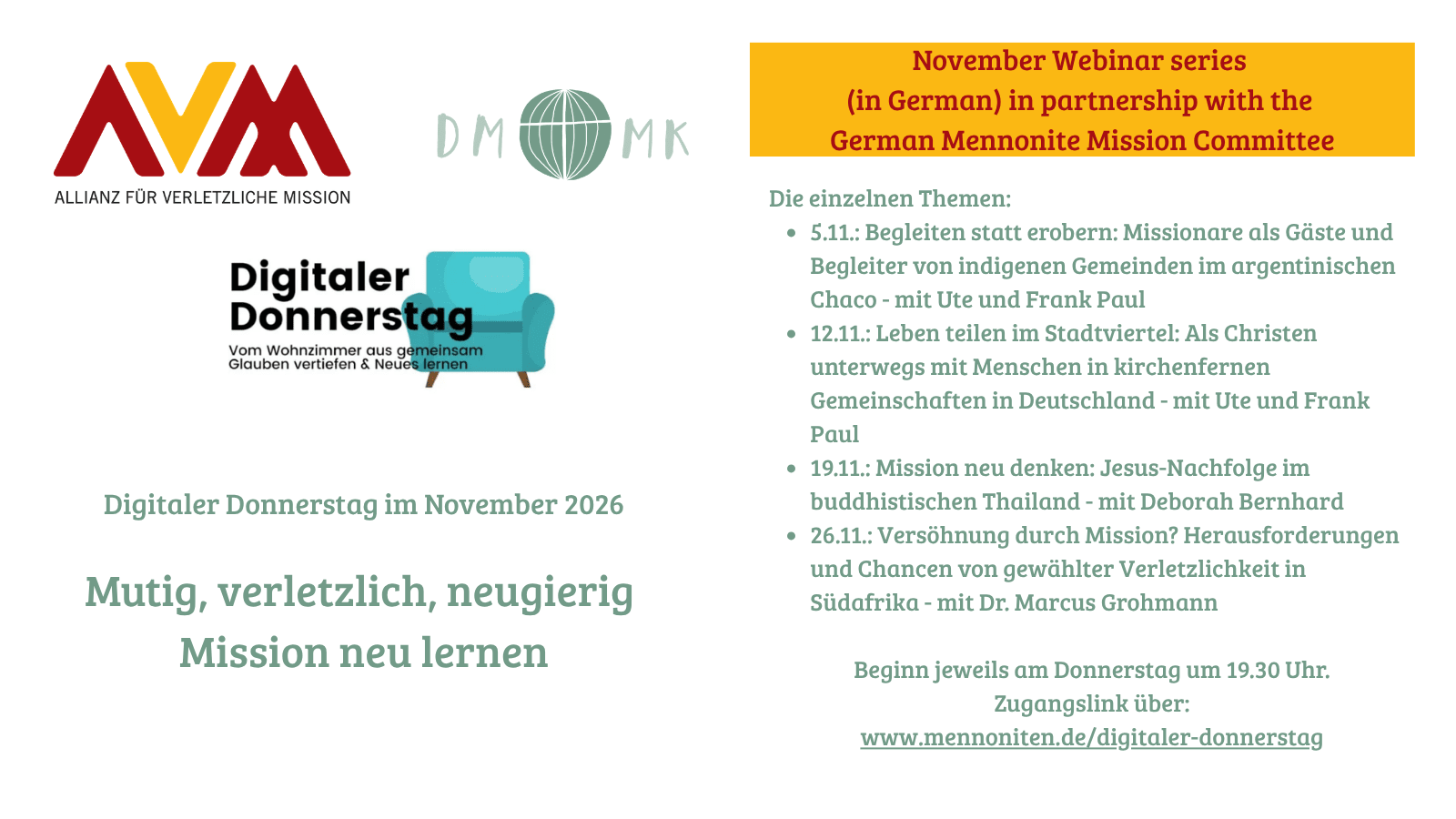
November: Digitaler Donnerstag zu Verletzlicher Mission – Webinar series in November in German

The German Mennonite Mission Committee (Deutsches Mennonitisches Missionskomitee – DMMK) have invited the AVM to run a webinar series on each of the four Thursdays in November 2026. Topics will include “Mission as accompaniment in the Argentine Chaco”, “Incarnational mission among unchurched working-class people in Germany” (both with Ute and Frank Paul), “Rethinking mission in the Buddhist world” (Deborah Bernhard) as well as “Considering reconciliation through mission in South Africa” (Marcus Grohmann).

Information on the individual webinar sessions and the Zoom link can be found here.

Image description

Report on the Webinar with Anna T. on Serving as Alongsiders in the Muslim World

Anna shared from her rich experience of working for many years, together with her husband, with people in Muslim contexts in several countries. She found that there was often an openness to exploring new ways of relating to God through discovering Jesus as Lord. They developed an unobtrusive way of journeying with people, not as complete outsiders, nor as insiders of Islam, but as alongsiders. This meant that people were not under pressure to deny or reject their communities and social structures, but were free to let their intimate relationship with Jesus develop. Anna shared how many people were remarkably open to learning more about God and Jesus through studying the Bible. Another way of allowing people to experience God’s presence and Jesus’ life-giving power was through guided “prayer for inner healing.” She provided insights into this aspect of pastoral care in intercultural and interreligious relationships and how it can help people find new life in Christ.

Image description

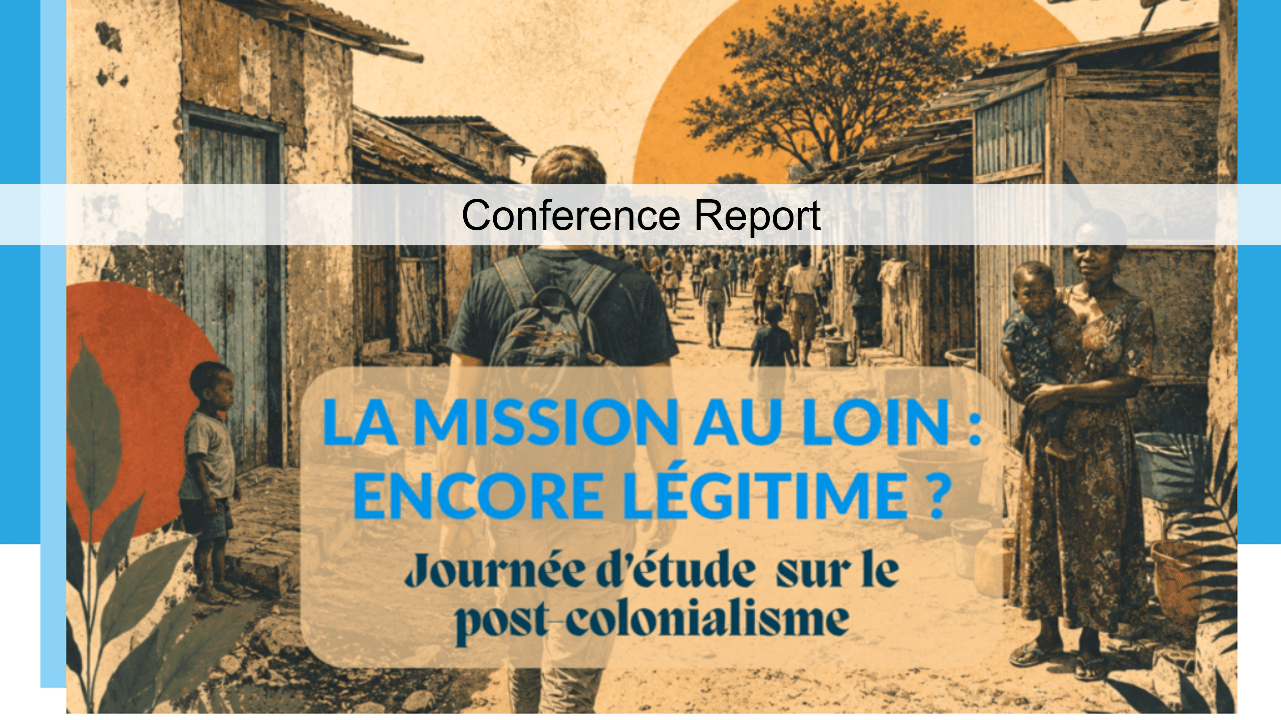
Mission in the postcolonial era – discussed in francophone Europe

Abbreviated conference report by participant Marcus Grohmann

On 3 October, the Reformed seminary HET-PRO (formerly Institut Biblique et Missionnaire Emmaüs) in Saint-Légier in Switzerland together with REMEEF*  gathered mission leaders, missiologists, students and missionaries for a conference with the central question: Is overseas mission (particularly by ‘Westerners’) still legitimate? This question was already loaded with assumptions and presuppositions – but the provocation was intended.

*Réseau de missiologie évangélique pour l’Europe francophone – the Network of evangelical missiology for francophone Europe

The conference with its evangelical speakers from a great variety of national and cultural backgrounds, affirmed the ongoing involvement in mission by those who are regarded as part of former colonial powers – but not unconditionally. The key question on which there seemed to be unanimity was, “How are Westerners involved in global mission today?” This concerned their modes of mission and their attitude towards those receiving them. But it also concerned their attitudes towards those Christians or missionaries (from the global South) who are received by them and their countries.


From an AVM perspective there is firstly reason for joy to see that debates that we know primarily from the English- and German-speaking world are had within French-speaking communities as well. Secondly, it was apparent that many important questions were being asked but that practical challenges around the use of local/outside languages and resources were not (yet) treated in depth. Apart from the general expediency of seeking collaboration across the different linguistic constituencies, this could be a place for Vulnerable Mission to contribute in the future.


The full report can be read here.

Image description

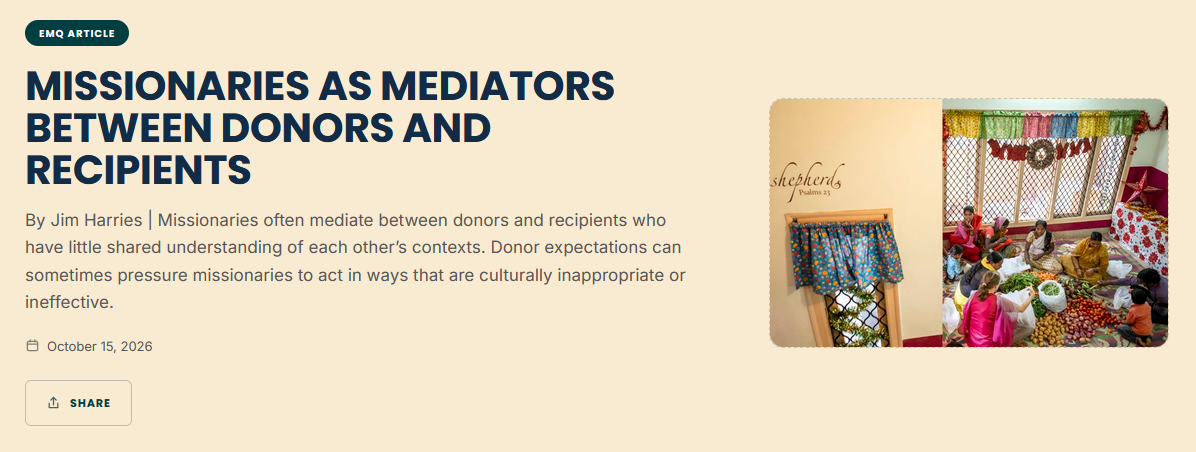
Jim Harries’ EMQ article on “Missionaries as Mediators Between Donors and Recipients”

This short article by Jim Harries is now available to subscribers to the EMQ (Evangelical Missions’ Quarterly). For non-subscribers, it will be open access in 1-year’s time. Jim in this article, gives a justification for a missionary’s becoming the sole formal link between people he works with on the field, and supporters ‘back at home’. The missionary is after all the one who studies culture and languages so is adept at translating and has a profound comprehension of both ways of life. Permitting, or encouraging, direct communication between, say, African people and European supporters, is to invite misunderstandings, that can seriously interfere with ministry.

Image description

Review of article on Vulnerable Mission

By James Alongi


The International Journal of Frontier Missiology has published this article by Marcus Grohmann describing Vulnerable Mission (VM) from three perspectives: (1) that of Jim Harries, founder of the AVM; (2) that of some critics of VM; and (3) his own experiences working in various churches in South Africa. Notably, the term "vulnerable" when applied to a Western missionary often suggests either intentional vulnerability or a "lack thereof" rather than an existential living condition, such as it might mean when used of many people around the world among whom Western missionaries work. Such intentional vulnerability includes self-restriction of one's use of colonial languages and non-local resources that indirectly promote "a more upscale lifestyle". It results in a missionary's personal adaptation for long-term accompaniment, heightened awareness of prevailing epistemologies and ontologies in a community, and certain criticisms of some concurrent missionary work that takes insufficient account of cultural dynamics.


Critiques of VM have come in two main areas: (1) The confinement of oneself to indigenous languages and resources; (2) the theology underlying VM. Regarding the first area, it has been thought that the use of local languages in contexts where a "national" language is preferred by locals allows a missionary to retain power over others' choice to opt-in to that national language; and regarding the second area, to some VM seems to theologically overlook a principle of sharing modeled by Jesus, as well as being essentially a Western-centric, overly-generalizing dialogue that has little application for non-Western missionaries. What these critiques often miss, Grohmann counters, is the over-arching goal of VM of understanding "local perspectives and beliefs that remain inaccessible" to missionaries who remain less vulnerable. In light of the fact that a biblical theology of vulnerability must prove its plausibility by being "expressed in local idioms and accepted by local people," as well as the observation that everyone represents themselves to some degree via generalization, Grohmann concludes that "The contribution of Jim Harries’ concept of VM to the discourse on (de)coloniality lies in its ability to render concretely the established connection between culturally shaped ontologies and epistemologies and language for intercultural practice."


Another, slightly longer academic review of Marcus Grohmann’s article was published by Dr Chris Flanders on the AVM website.

Image description

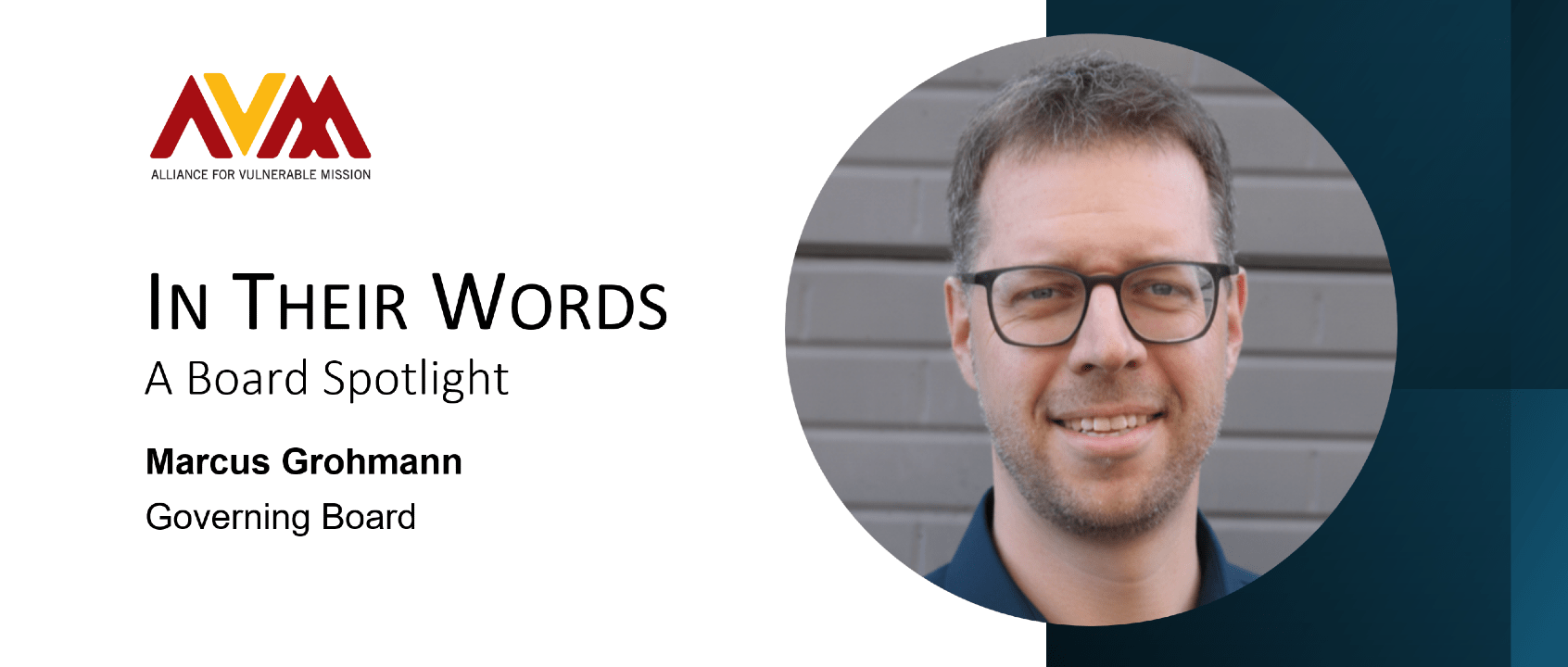
In Their Words – A Board Spotlight

This series introduces the people serving on the boards of the Alliance for Vulnerable Mission. This month, Marcus Grohmann, who has been leading the AVM as its director since 2024, introduces himself:


When I first encountered vulnerable mission through meeting Jim Harries at a missions conference in Germany in 2011, I felt both drawn in and challenged. Relating to others on their own terms in intercultural encounters had long been on my heart. Now I began to grasp more deeply how power differentials manifest themselves in identity, knowledge and socio-religious traditions. I set out to discover how vulnerable mission’s approach to mitigating such inequalities – using local languages and resources – related to my anthropological research focus: church-based post-conflict reconciliation and intercultural theological practice.


At the time I was a university ministry worker with SMD (the German branch of the International Fellowship of Evangelical Students, IFES), while also involved in partnership work with reconciliation ministries in Rwanda. Since 2016, I have been living in South Africa. My PhD research on post-apartheid reconciliation in a multicultural congregation led to a postdoctoral fellowship at the Department of Practical Theology and Missiology at Stellenbosch University. I also assist with part-time lecturing at a township Bible school for leaders of indigenous churches, where the curriculum is taught in isiXhosa.


Through this triad of academic work, grassroots theological training and advocacy with the AVM, I hope to bridge academic and practitioner contexts, challenge both church and secular settings, and engage both evangelical and ecumenical communities. The goal is to prompt reflection on the often hidden, ingrained ways we dominate others in intercultural contexts, and to journey with people towards more intentional vulnerability in their work and ministry.

Image description

Evangelical Missiological Society call for papers

The 2027 EMS Annual Conference theme is Leading in Missions: Diverse Voices and Practice in Global Witness (see below for details).


As usual, there will be a number of pre-conferences. The Global Region Conference will take place from 19-20 March 2027 (fully online).


The Global Region Conference welcomes papers on all topics relating to evangelical missions. This is a good forum to present your research for discussion and feedback. Papers not being considered for the annual conference can be between 2000-5000 words. Feedback will be given on the potential for publication.


Additionally, papers on “Leading in Missions” can be submitted for consideration for presentation at the annual conference in Dallas, USA, in October. These papers must be 4500-7000 words and use Chicago Turabian author-date citation.


The annual conference will be hybrid. To present at the Annual Conference in October, you must be recommended by the Global Region Conference in March. Only papers focused on the annual conference theme will be recommended. Some of these papers are then considered for publication in the Conference Compendium.


To present in the Global Region Conference, you need to submit:

  1. an abstract by Friday, January 15th – Use this linked form to submit your abstract. - You should hear back regarding the acceptance of your abstract within 2 weeks.

  2. your paper AND a 10 minute recording of your presentation by Friday, February 19th. – Email your paper and recording to Dr Evelyn Hibbert ([email protected]).

Papers and recordings will be made available online for Global Region Conference participants two weeks prior to the conference. Participants will have the opportunity to comment and interact with the authors and each other prior to the conference meetings. Conference sessions will be for discussion only. (It will be assumed that participants have already watched the presentations and read the papers.)


You will receive written feedback on your paper by conference attendees. If your paper is recommended for the annual conference, it will need to be fully ready for submission to the annual conference committee by April 23rd.


See full call for papers and description of the theme of the annual EMS conference here.

Image description

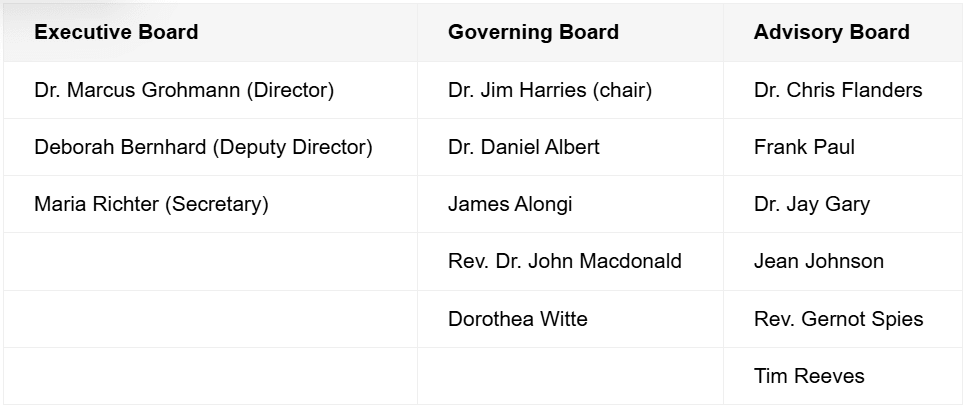
The AVM Bulletin is published by Allianz für Verletzliche Mission e. V. / Alliance for Vulnerable Mission (AVM), registered under Association Register Number 14892 by the local court in Dresden. The AVM is represented by executive board members Marcus Grohmann, Deborah Bernhard, and Maria Richter. Contact via phone (+27 81 586 1484) or email ([email protected]).

By signing up for the AVM Bulletin, you agreed to our Privacy Policy. This includes receiving AVM-related news as well as the possibility of occasionally receiving direct fundraising requests. If you do not wish to receive such fundraising communications, please let us know via this link or by contacting us directly. Your subscription to the AVM Bulletin will not be affected.

Mit der Anmeldung zum AVM Bulletin haben Sie unserer Datenschutzerklärung zugestimmt. Diese umfasst den Erhalt von AVM-bezogenen Nachrichten sowie die Möglichkeit gelegentlich direkte Spendenanfragen zu erhalten. Falls Sie keine solche Fundraising-Mitteilungen erhalten möchten, teilen Sie es uns bitte über diesen Link oder direkte Kontaktaufnahme mit. Der Bezug des AVM-Bulletins bleibt davon unberührt.

Allianz für Verletzliche Mission e. V.

Heynathsstr. 7, 01309 Dresden
Germany

You received this email because you signed up for it. You can unsubscribe at any time.

If you would like to unsubscribe, please click here.
Powered by Sender.net